

 RSMUS.com
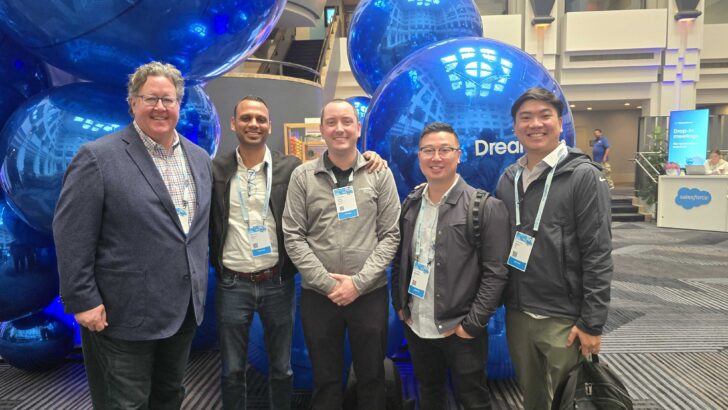
After spending several days at Dreamforce 2026 speaking with clients, Salesforce leaders, technology partners, and fellow practitioners, one thing became abundantly clear: Salesforce is no longer talking about the future of AI. They’re talking about operationalizing it.
Last year’s conversation centered on possibility. This year’s conversation focused on execution. Throughout the week, Salesforce showcased how businesses are moving from AI experimentation to AI embedded directly into sales, service, operations, and customer engagement processes through Agentforce, AIforce, Claudeforce, and a growing ecosystem of autonomous agents.
For commercial organizations across manufacturing, distribution, life sciences, business and professional services, software, and technology sectors, the implications are significant. In my view, the biggest takeaway from Dreamforce was not a specific product announcement. It was a fundamental shift in how Salesforce believes work will be done in the future.
Salesforce is becoming the intelligence layer of the enterprise
One of the most discussed announcements at Dreamforce was AIforce, Salesforce’s new interface strategy that brings Salesforce data, workflows, security, and business context into whatever application employees already use, including Claude, Slack, and Salesforce itself.
Historically, organizations expected users to come to Salesforce. The new vision is the opposite: Salesforce is increasingly bringing CRM intelligence to employees wherever they work.
For many organizations, this is a meaningful shift. Sales representatives may interact through Claude. Service teams may work through Slack. Executives may consume insights through conversational interfaces instead of dashboards. Yet behind the scenes, Salesforce remains the system governing customer relationships, workflows, permissions, and business processes. For middle-market companies, this has the potential to accelerate adoption because employees can engage with CRM data in more natural ways without changing their daily work patterns.
Data readiness is becoming the biggest differentiator
While AI generated most of the headlines, the conversations I had throughout the week consistently returned to a less glamorous topic: data quality.
Organizations want AI. They want agents. They want automation.
What many still lack is the trusted data foundation required to make those investments successful. Throughout Dreamforce, Salesforce repeatedly emphasized trust, governance, permissions, observability, and security. Whether discussing Agentforce, Claudeforce, Koa, or the Trusted Enterprise AI Harness, the underlying message was consistent: AI effectiveness depends on the quality of the information and processes supporting it.
For many organizations, that means addressing challenges that predate AI entirely. Customer information often lives across Salesforce, ERP systems, marketing platforms, service applications, data warehouses, and other operational systems. Before agents can reason across the business and take meaningful action, companies need a strategy for integrating data, establishing trusted customer records, governing information, and making business context available across systems.
It’s one reason we continue to see growing interest in platforms such as Salesforce Data Cloud, Informatica, and MuleSoft. While these technologies serve different purposes, they all help address a common challenge: connecting and governing data across the enterprise so AI can operate with greater confidence, context, and accuracy. In many ways, Dreamforce reinforced something we’ve seen firsthand with data modernization initiatives: AI readiness is ultimately a data readiness challenge.

Agentforce is moving from concept to business value
Another noticeable change from prior events was the maturity of Agentforce. At Dreamforce 2026, Salesforce introduced a growing portfolio of job-ready agents designed for sales, service, commerce, employee support, and operational processes. They also showcased long-horizon agents capable of pursuing goals over days or weeks, rather than simply responding to a single prompt or request. What stood out was the shift from hypothetical demonstrations to measurable business outcomes.
The examples shared throughout the week focused on:
- Lead qualification
- Customer support automation
- Service case resolution
- Sales productivity
- Supply chain coordination
- Back-office process execution
These are the exact areas where many commercial organizations continue to face resource constraints, labor shortages, and pressure to improve profitability. For manufacturers, distributors, and technology companies especially, Agentforce is beginning to move beyond innovation discussions and into operational strategy.
Industry expertise matters more than ever
Among the announcements that resonated most with me was Salesforce’s partnership expansion with Siemens, which demonstrated how industry-specific data and workflows can be connected directly to customer-facing sales and service experiences. That announcement reinforced something we’ve observed for years: technology alone rarely creates competitive advantage – business context does. An AI solution trained on generic information can be helpful, but AI solution grounded in a company’s products, customer relationships, service history, operating procedures, and regulatory requirements becomes transformational. This is particularly relevant in industries like life sciences, manufacturing, and business services, where complex processes and specialized knowledge often determine customer outcomes. As AI becomes more accessible, industry expertise will become an even more important differentiator.
Governance is becoming a boardroom conversation
Another recurring theme at Dreamforce was governance. Many organizations have moved beyond asking whether they should adopt AI. They’re now asking how to govern it responsibly. Salesforce’s Trusted Enterprise AI Harness, AI Control Plane, observability tools, agent monitoring capabilities, and security-focused messaging all point to a future where AI governance becomes a core business capability rather than an IT concern.
This is especially relevant for regulated industries and companies managing sensitive customer information. The organizations that succeed with AI will likely be those that combine innovation with strong controls, clear accountability, and disciplined operating models.
Looking ahead
As I reflect on Dreamforce 2026, I believe the most important takeaway is that AI is quickly moving from an emerging technology initiative to a business transformation initiative. The conversation is no longer about whether AI can create value. The conversation is about how organizations establish the data foundation, governance framework, operating model, and process maturity required to capture that value at scale.
For commercial organizations, the opportunity is substantial. The companies that begin laying those foundations today will be best positioned to take advantage of the next generation of Salesforce capabilities, whether through Agentforce, Claudeforce, AIforce, or whatever comes next.
I left Dreamforce thinking that CRM is evolving into something much bigger: the trusted intelligence layer that powers how work gets done across the enterprise.
If you’re interested in understanding how these announcements impact your business, connect with me on LinkedIn and drop me a line, or reach out to RSM here.


Kevin Ma
Kevin is a Director in the Salesforce practice and leads the Salesforce Core team. As a Salesforce and Enterprise Architect, Kevin has delivered many successful implementations with clients across diverse industries, from education to healthcare. Kevin's experience covers nearly the whole Salesforce suite and he strives to deliver to clients an efficient, integrated, and foundational CRM solution that continuously adapts to changing needs. Kevin is a leader in the RSM Salesforce practice and recently received the Rising Stars Award from ALM Consulting Magazine.