


 RSMUS.com
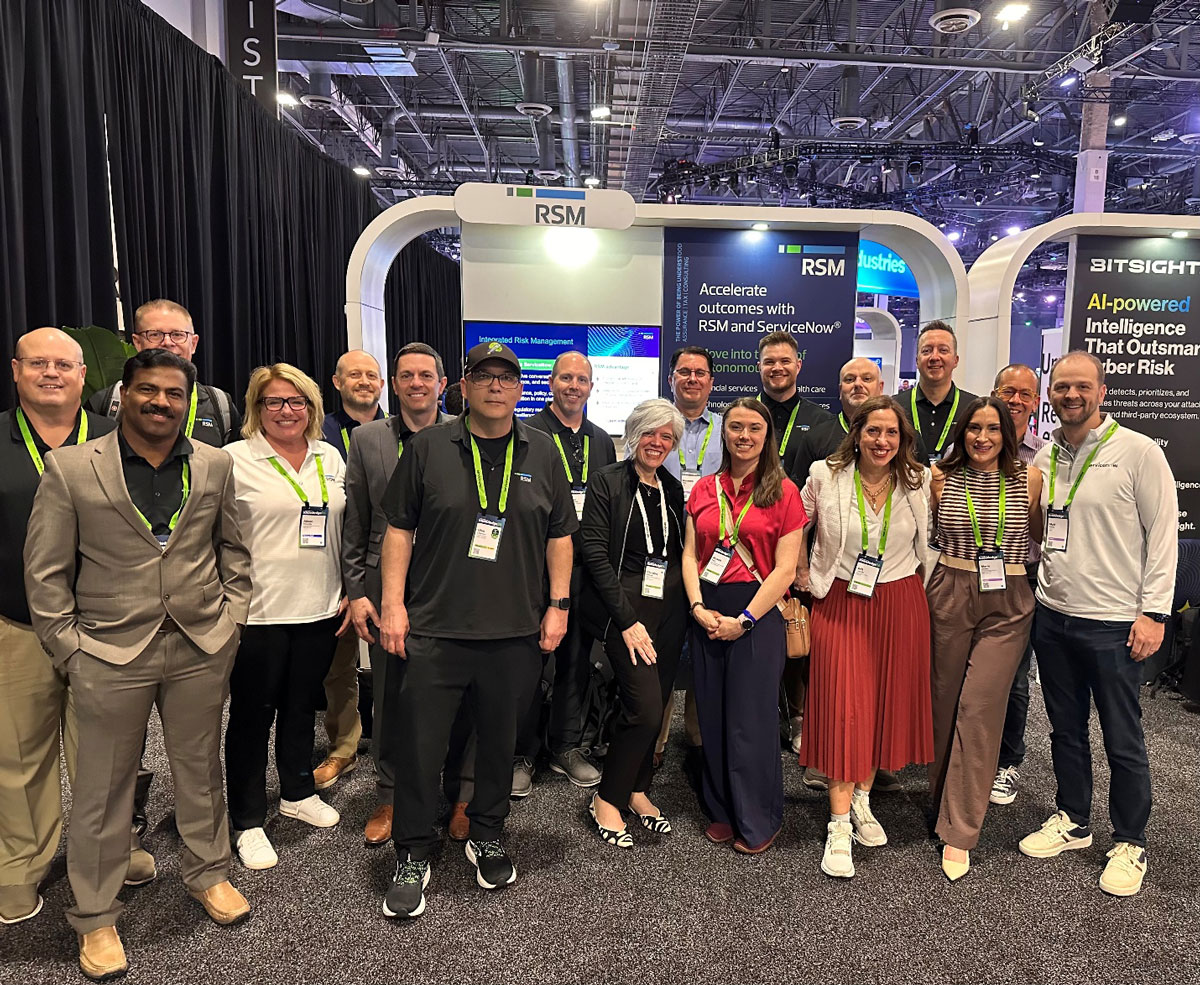 ServiceNow’s annual flagship conference, Knowledge (K26), was hosted at the Venetian in Las Vegas from May 5th-7th, 2026. The event was attended by an estimated 25,000 individuals including customers, partners, employees, enterprise leaders, and speakers all sharing the energy and excitement of the three-day event. There were many exciting announcements made during the conference; in this article I’m sharing my top takeaways from the event. The dominant message at K26 was the evolution over the last year from AI merely helping and assisting with work within organizations, to Agentic AI completing the work end to end; we are past the point of assistance and suggestions. With organizations planning to scale AI across the business, control, visibility, and governance are paramount for success. The theme of governance was reinforced from the main stage of the Keynotes, conversations, hands-on labs, and throughout the Expo floor.
Agentic AI in Action
As a ServiceNow MVP, I was invited to attend the 2026 MVP Summit on May 4th before the conference officially started. The focus of the summit was learning how ServiceNow’s Build Agent can be utilized to create custom applications on the platform using natural language prompts. Using Build Agent for the first time, I envisioned a real use case that has been a topic of conversation within the user group and meetup communities. An application that would pair and match mentees to mentors, and would consider time zones, availability, topics of interest, and experience within specific areas of the platform.
The prompt I used instructed the AI to interview me for the requirements and details of the application. The process was iterative as the AI repeatedly asked for context and clarification of the purpose and desired outcomes of my vision. The AI reminded me of an experienced Business Analyst requesting information and clarification ensuring the purpose of the application was understood. Following a 20 min interaction of answering questions, Build Agent’s AI provided a summary for review prior to creating the application. The automated build of the application was completed in 15 mins and included database tables and relevant fields, an intake form, role-based access, reports, demo data, and a workflow which included approvals. Although the result would require further development, the foundation of the mentee mentor application was impressive and solid.
In hindsight, the experience taught me that you need to be intentional and extremely specific with your prompts. I made assumptions, specifically with field data, that I thought enough context was provided; I learned you cannot make any assumptions.
If your organization has a basic workflow that is repetitive and managed manually today, within Excel as an example, I recommend utilizing ServiceNow’s Build Agent in your development environment to create a custom application. Write extremely clear and detailed prompts for success. “Create an onboarding workflow” does not provide enough context; instead, an example could be “Create an employee onboarding flow for ITSM using Flow Designer. Start the Flow when HR creates a new hire Case. Create tasks for computer provisioning, ID badge, and installation of software. Include Service Level Agreements and Manager approval. Create an intake form within Employee Center that captures the requestors name, manager, location, cost center and software options for Adobe and Google Chrome.” I highly recommend using an interview method and continue asking the AI for recommendations, suggestions, and anything you may have missed. The resulting application may not be perfect, but I’m confident the result will be a solid protype built in minutes instead of hours.
As organizations adopt and utilize Build Agent, the product will learn from what is created within their instance by developers and continuously improve. Build Agent’s value and near future will provide business technologists and citizen developers with the capability to create applications while completely removing the technical aspect of the process.
Autonomous Workforce Doing the Work
Further expansion of Agentic AI was announced with new Autonomous Workforce Agents. ServiceNow already introduced L1 IT Service Desk AI Specialist agents, and at K26 the list grew to include AI Specialists across HR, workplace services, legal, finance, procurement, supplier management, security and risk, and health and safety. The role-based AI Specialists act as teammates automatically resolving requests and cases, issues and incidents, and threats without human intervention within your organization while providing a full audit trail. How effective are these agents? ServiceNow announced their own adoption of the L1 IT Service Desk Agent within their own helpdesk resolving assigned IT cases 99% faster than human agents.
My recommendation to enable successful autonomous workforce agent deployment is to ensure foundational elements are in place. Agents will rely on trustworthy data for decisions:
- CMDB health and accurate CI relationships will be paramount with incident resolution
- High quality knowledge articles will be required for trustworthy recommendations
- Autonomous fulfillment will require clear and concise workflows, I foresee challenges with excessive branching and exception scenarios
- Start with a basic use case for a pilot
A basic use case example is a user submits an incident; the agent categorizes the incident utilizing the category / subcategory or the service / service offering fields; the agent proposes a knowledge article for remediation. A Flow is started to send an approval task to a human for review, and orchestration automation could be utilized to restart a server. Finally, the agent provides a summary of the resolution steps for documentation purposes. This example would have high value within an organization without risk as human approval is required to ensure accuracy and governance is embedded in the process.
I see AI Specialists enabling organizations to truly transform from reactive resolutions to proactive service management. As digital agents’ action on tasks completing workflows from beginning to end, the main theme of K26 emerged. Governance cannot be an afterthought; it must be the architecture.
AI Control Tower – Governing the Chaos
CEO of ServiceNow, Bill McDermott, said that the AI revolution is already happening. With the shift from generative AI assisting us with work to agents automatically completing work end to end, organizations must consider governance. He described a path to chaos, an AI blind spot with the uncontrolled expansion of agents within enterprise networks. The deployment of agents requires clear guardrails and audit trails to prevent data leaks or rogue actions. A statement that resonated with me was “We know what AI can do for our business, but we need to pay attention to what AI can do to our business.”
An example of a rogue agent was provided as an example. An agent running within a global shipping company’s network unexpectedly decreased shipping costs to only one dollar; a catastrophic impact on the business. ServiceNow is addressing this problem, the AI blind spot, by positioning the platform as the enterprise management layer for any AI that your business is using with AI Control Tower. A centralized command center bringing visibility to discover, observe, govern, secure and measure AI deployed across and discover all AI running within your organization whether internally built, third-party sourced, or agent driven. AI Control Tower lets customers act with confidence across five dimensions:
- Discover: Finds AI agents deployed across the organization including systems beyond ServiceNow. It utilizes integrations such as Amazon Web Services, Google Cloud, Microsoft Azure & 365, and enterprise applications such as SAP, Oracle, and Workday.
- Observe: Provides continuous monitoring with live metrics and alerts, replacing periodic audits for ROI analysis. AI Control Tower now delivers deep visibility into AI agent behavior, giving teams actionable data into how agents reason, where they make decisions, and if human intervention is required.
- Govern: Delivers AI-driven risk assessments across all types of AI, not only agents but also models, data sets, and prompts. New risk frameworks aligned to NIST and EU AI Act standards provide compliance controls out of the box.
- Secure: When an agent goes off script or operates beyond its permissions, AI Control Tower can detect it, escalate and shut it down in real time with a single click. Granting organizations the kill switch they need as agents take on more critical work.
- Measure: Provides cost tracking and ROI dashboards that give customers financial control as they scale AI. This addresses runaway model spends, one of the most pressing challenges enterprises faces as AI deployments grow.
Before considering AI Control Tower, I recommend first establishing AI current state understanding and visibility. Which AI tools are being used within your organization? Is there an owner or accountability established? What data is accessible? What decisions are your organization comfortable with leaving entirely at the discretion of AI? Governance policies can then be considered such as required human approval, audit logging, escalation paths, and steps to rollback actions if required. With guardrails in place, AI Control Tower provides visibility, governance, and the ability to operationalize and scale AI safely.
K26 Core Theme
The overall message that I heard loud and clear at K26 was that organizations that simply race to adopt AI will not see success or ROI; speed without a plan is not the answer. Business must have visibility, understanding, security, and governance as AI is scaled across the enterprise in the years to come. ServiceNow’s AI Control tower provides organizations with the ability, confidence, and trust for AI leaders to take control and bring light to the AI blind spot.

Glen Chiasson
Experienced Practice Manager, Engagement Manager and People Leader working exclusively on the ServiceNow platform since 2013. Excels at developing trusted client relationships by understanding pain points and needs, project team leadership, and successful project delivery ensuring scope, budget and timelines are met by managing client expectations, accurate budget forecasting and resource allocation. Consistently promotes practice and pipeline growth by identifying deeper platform adoption utilizing future state road mapping aligning to client strategic objectives. Advocate of sharing knowledge, industry experiences and mentoring others. Founding organizer of the Vancouver ServiceNow Developer Meetup Group.